



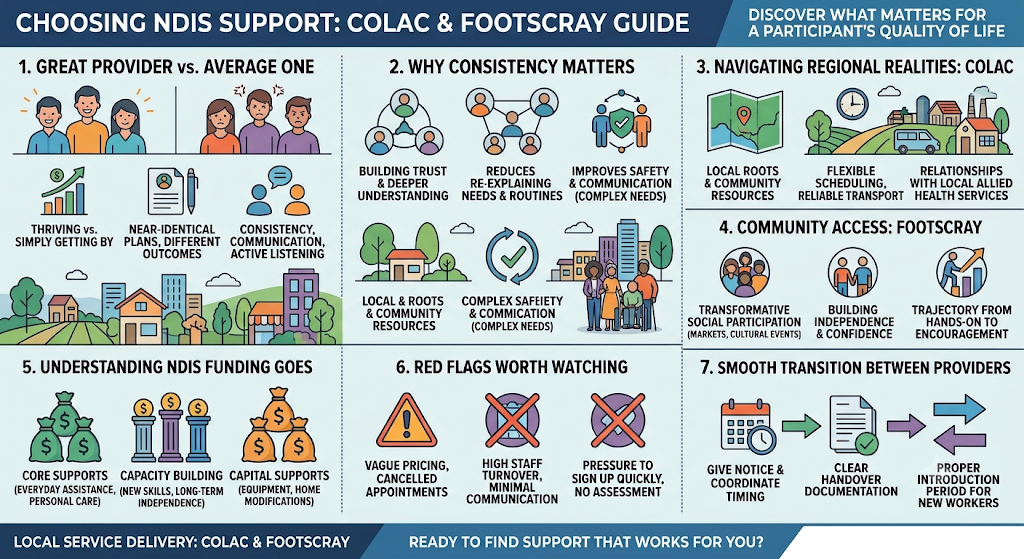
Every NDIS plan comes with funded hours, categories, and goals written on paper but it’s the provider delivering those supports who determines whether a participant actually thrives or simply gets by. Two people with near-identical plans can end up with completely different outcomes depending on who they work with. Finding a genuinely capable NDIS provider Colac families trust often comes down to details that never appear in a glossy brochure: consistency, communication, and whether staff actually listen.
The Hidden Cost of Choosing the Wrong Provider
Switching providers is more common than most people realise, and it’s rarely about a single bad incident. More often, it’s the slow accumulation of missed appointments, rotating staff who don’t know the participant’s needs, and support that feels transactional rather than genuinely person-centred. A disability services and support organisation that gets the fundamentals right avoids this pattern entirely by investing time upfront to understand goals, communication preferences, and family context before support even begins.
Consistency of Support Workers Matters More Than People Expect
Ask any experienced participant or carer what they value most, and staff consistency almost always tops the list. Building trust with a support worker takes time, and constant turnover forces participants to re-explain their needs, preferences, and routines over and over. A quality provider prioritises rostering the same small team of workers wherever possible, rather than filling shifts with whoever is available that day.
This consistency also improves safety and communication, particularly for participants with complex needs, sensory sensitivities, or communication differences that take time for a support worker to properly understand.
NDIS Provider Colac: Navigating Regional Realities
Regional service delivery comes with genuine logistical challenges that metro providers rarely face: fewer allied health professionals nearby, longer travel times between appointments, and a smaller pool of support workers to draw from. A capable NDIS provider Colac participants can depend on typically addresses these realities head-on, offering flexible scheduling, reliable transport coordination, and strong relationships with local allied health services to reduce the friction regional participants often experience.
Regional providers with genuine local roots also tend to understand community resources better than a metro-based organisation trying to service the area remotely, which translates into more relevant, practical support recommendations.
Community Access Footscray: More Than Just Getting Out of the House
Community access Footscray support is often misunderstood as simple supervision, but done well, it’s genuinely transformative. Footscray’s diverse community offers rich opportunities for social participation: markets, cultural events, public transport, employment programs and skilled support workers use these opportunities deliberately, building confidence and independence rather than just providing a chaperone.
The best community access support has a clear trajectory: participants gradually take on more independence as skills and confidence grow, with the support worker’s role evolving from hands-on assistance to lighter-touch encouragement over time.
Understanding Where Your Funding Actually Goes
NDIS funding categories can feel confusing, but understanding them helps participants use their plan more effectively:
- Core supports – everyday assistance covering personal care, community access, and consumables.
- Capacity building supports – services focused on developing new skills and long-term independence.
- Capital supports – funding for equipment, assistive technology, or home modifications.
A provider who takes time to explain these categories clearly rather than assuming participants already understand the system makes a noticeable difference in how confidently people use their plans.
Red Flags Worth Watching For
Not every provider delivers on its promises. Warning signs worth taking seriously include vague or evasive answers about pricing, frequent last-minute cancellations, high staff turnover, minimal communication about progress toward goals, and pressure to sign up quickly without a proper needs assessment. A provider genuinely confident in their service quality will welcome questions rather than rushing participants through the sign-up process.
Making a Smooth Transition Between Providers
Changing providers doesn’t need to disrupt support if it’s managed properly. A well-run transition includes clear handover documentation, coordinated timing with the outgoing provider, and a proper introduction period so new support workers understand the participant’s needs before taking over daily support. Providers experienced in transitions will manage this process proactively rather than leaving participants to coordinate the handover themselves.
Ready to Find Support That Actually Works for You?
Whether you’re searching for a dependable NDIS provider Colac participants trust, meaningful community access support, or a well-rounded disability services and support organisation that genuinely listens, Relight Your Care Pty Ltd the right provider that can transform your entire NDIS experience. Get in touch today to discuss your goals and find out how the right support team can help you build a more independent life.
What should I do if I’m unhappy with my current provider?
You can give notice and arrange a start date with a new provider, with minimal paperwork required to transition.
What’s the difference between core and capacity building supports?
Core supports cover daily assistance, while capacity building focuses on developing skills and long-term independence.
Do I need a support coordinator to find the right provider?
Not necessarily, though a support coordinator can help navigate complex plans and connect you with suitable options.
Can community access support help with employment goals?
Yes, many providers offer support specifically designed to build work-readiness and workplace confidence.
How are support hours typically billed?
Providers generally bill according to the NDIS price guide, with rates varying by service type and time of day.
What happens if my regular support worker is sick or unavailable?
Reliable providers maintain backup staffing arrangements to avoid gaps in scheduled support.
Can NDIS funding cover social or recreational activities?
Yes, provided the activity aligns with your plan goals and sits within a funded support category.
How often should my support arrangements be reviewed?
Most participants review progress every three to six months, alongside formal NDIA plan reviews.
Is quality support genuinely available in regional areas like Colac?
Yes, a growing number of providers now offer dedicated regional services built around local access and transport realities.
